System administrators in large IT environments and multi-site systems need a simple way to gain visibility and control over their increasingly complex infrastructures. With PRTG Network Monitor, we use a comprehensive monitoring solution that is consistently optimized for performance, clarity, and ease of use.
Greater security and efficiency through IT monitoring for industry, healthcare, and the public sector.
Minimize costs caused by IT outages, prevent performance bottlenecks, and free up personnel resources for IT administration and support.
Monitoring can be this simple. PRTG monitors your entire IT infrastructure. You have a clear view of your network's performance and ensure that all business-critical components are available.
PRTG Network Monitor stands out for its performance, clarity, and ease of use. With PRTG, you can keep an eye on your entire infrastructure:
Ready to go in just a few minutes and consistently optimized for maximum ease of use:
Integrated technologies - With PRTG, we have more control and a better overview of your IT systems at all times.
All major technologies are supported:
Intuitive monitoring that is easy to use:
We visualize your IT systems in real-time overview maps with live status information.
Using the PRTG Map Designer, we integrate all your network components into dashboards with over 300 different map objects—from device and status indicators to traffic charts and top lists.
We customize your map with user-defined HTML elements. We share the URL of your maps with you internally via your LAN.
PRTG alerts us—and you, if desired—when problems or unusual values are detected. PRTG can automatically send alerts when issues or unusual values are identified.
To do this, PRTG offers a wide variety of notification methods, such as email, push notifications, or HTTP requests. Thanks to free apps for Android and iOS, you can also receive push notifications directly on your mobile phone.
We tailor all notifications to your needs, create schedules for alerts (e.g., "no low-priority alerts at night"), and avoid notification floods by using dependencies.
With our PRTG API, we can create completely customized notifications.
All systems, devices, traffic, and applications in your IT infrastructure are monitored. PRTG runs without the need for add-ons or additional plugins. PRTG is a powerful and easy-to-use monitoring solution for businesses of all types and sizes.
PDF download: 6 good reasonsDetermine how much bandwidth your devices and applications are consuming and identify bottlenecks.
Monitor your databases with individually configured PRTG sensors and SQL queries.
Manage your applications and receive detailed statistics on all applications within your IT systems.
Manage your cloud services from any location and monitor them centrally.
Monitor your servers in real time and check their availability, accessibility, capacity, and overall reliability.
Keep an eye on your entire local network, including workstations, routers, switches, servers, and printers.
Monitor countless devices with PRTG and via SNMP.
In digitized industrial environments, the worlds of Operational Technology (OT) and traditional IT are closely intertwined. This includes programmable logic controllers, industrial PCs, intelligent industrial gateways, and sensor technology, as well as classic IT infrastructure components such as network switches, routers, and wireless components.
To monitor all of this, you need a solution that can consolidate OT and IT into a single view.
If OT and IT are converging, shouldn't your monitoring bring both worlds together, too?
PRTG is a holistic monitoring solution that integrates elements from both IT and OT into a unified view, reducing complexity and infrastructure costs while helping system engineers ensure the availability of their infrastructure.
PRTG adapts completely to your requirements and allows you to visualize your IT and OT data
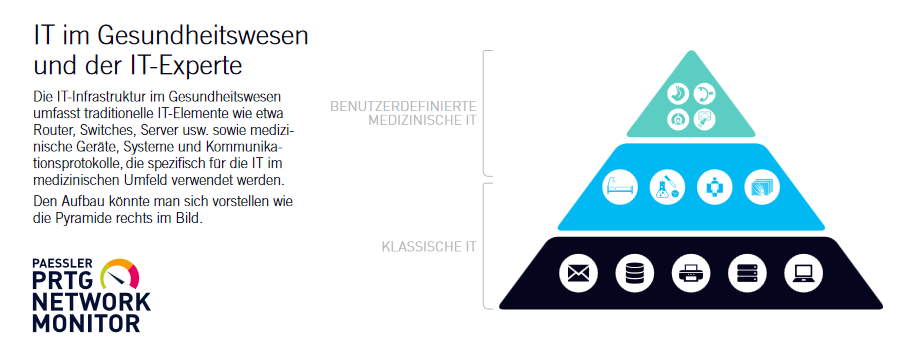
Modern hospitals are highly digitized. At the center of this digitization is the availability of patient data. Classic IT systems and medical IT must work together seamlessly and require centralized monitoring.
PRTG makes monitoring simple while ensuring optimal performance and user-friendliness.
Modern hospitals are highly digitized
Where 15 years ago the doctor still had an impressive clipboard for X-rays on the office wall—directly above the shelf with all the patient files—today there is a monitor, or the doctor even holds a tablet in their hand. In any case, the doctor wants access to all relevant information about their patient.
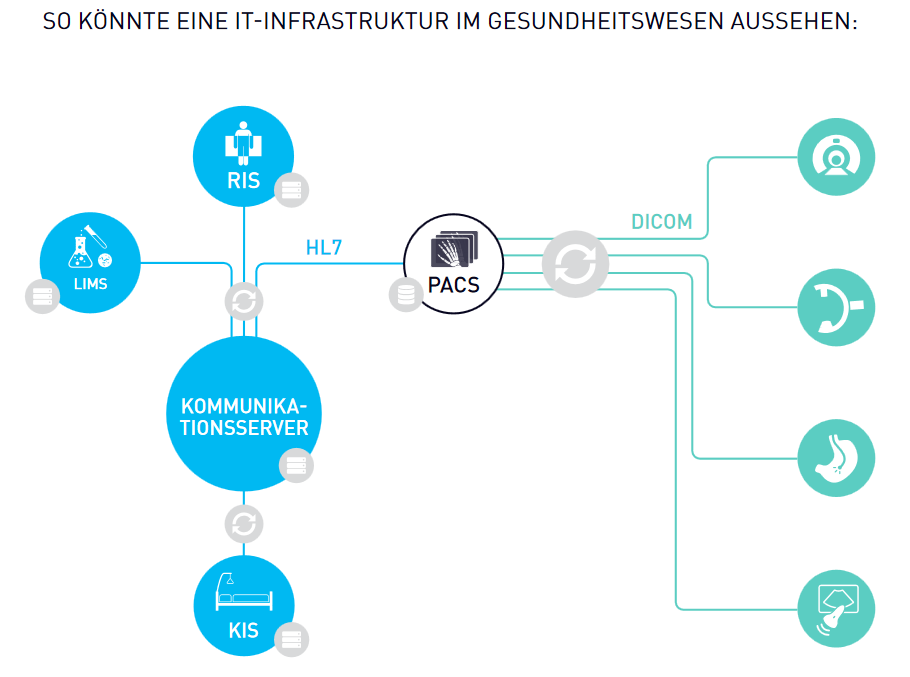
In addition to image data such as X-rays, MRIs, or ultrasound, this also includes lab values and history, information about the family doctor, specialist reports, and so on. All this data is transported via the various hospital systems, such as:
- HIS (Hospital Information System) - Master data management
- LIMS (Laboratory Information and Management System) - Lab results
- RIS (Radiology Information System) - Radiology reports
The image data generated by various imaging devices such as X-rays, MRIs, ultrasound, or video endoscopes are stored on the PACS (Picture Archiving and Communication System).
Meanwhile, most hospitals use a central communication server that connects the different systems and is thus able to provide the doctor with all information about their patient.
Finding the right monitoring solution
A monitoring solution for your classic and medical IT systems should meet all standard requirements such as functional scope, user-friendliness, price-performance ratio, implementation effort, and technical support.
In this case, you should also pay attention to the following aspects:
All medical technology devices require a classic IT infrastructure for communication, which handles data transport and provides the hardware basis for the various systems. Cables and switches are needed for this. Servers and storage systems, but also the WLAN including its access points, play an important role.
Only when classic IT performance and security are guaranteed can it satisfactorily fulfill its task as the foundation of medical technology. This requires comprehensive IT monitoring. Availability of devices, data traffic, performance of applications—all of this must be continuously monitored. Now, IT or network monitoring is not a new topic. Accordingly, the range of corresponding solutions is large and versatile. However, these solutions usually do not provide options for integrating medical technology into the monitoring.
Added to this are the numerous security systems. Today, hospital IT is no longer an isolated system, but is networked in many areas with other institutions (health insurance companies, doctors, building services, administration). Firewalls, virus scanners, intrusion detection systems—especially with regard to sensitive patient data, there are extremely high security requirements.
Custom dashboards
With PRTG, you can create your maps in HTML format via drag-and-drop in minutes. PRTG brings the two worlds of classic IT and medical technology together in one view. You can use drag-and-drop to create custom dashboards that clearly map all processes, including all involved components in the hospital, immediately display malfunctions, disturbances, and outages, and, if necessary, immediately inform or alert the responsible persons.
Monitoring geographically separated networks
Many hospitals have different locations. An important feature of PRTG for this is the so-called Remote Probes. These allow for the monitoring of multiple separate networks, even up to geographically separated clinics within a network, using a single instance of PRTG or a single license. Another feature in PRTG is the custom REST sensor. It allows the administrator to easily integrate all devices that offer a REST API into PRTG. This can include refrigerators, sensors for monitoring temperature, air quality, or humidity, as well as building security systems.
RESTful API
This way, PRTG can connect communication servers such as Orchestra from Soffico via the REST Custom Sensor using its RESTful API. Using DICOM, the transmission of image data can be controlled, and devices such as X-ray machines, MRIs, ultrasound, or video endoscopy can be included in the monitoring. HL7 is the common protocol for transmitting patient-related data. Thanks to native HL7 support, PRTG can include systems such as HIS, RIS, or LIMS in the monitoring.
The PRTG alarm system
Of course, all functions for data acquisition, storage, analysis, and publication can be used in the medical technology sector just as they are in the classic IT network. For example, individual thresholds can be defined, and in the event of a fault, corresponding alerts can be sent via email, SMS, push notification, or other mechanisms. This allows, for example, significantly more flexibility for on-call duty.
Sensors and data security in healthcare
In PRTG, the REST Custom Sensor as well as the data protocols, DICOM and HL7, have been expanded to make centralized monitoring for the healthcare sector even easier.
Patient data is managed and transmitted via HL7; PRTG uses HL7 to ensure secure data transfer and to monitor the involved computers. PRTG does not have access to personal data. Only data type, data volume, paths, and device status are monitored.
Modern e-government does more than just streamline a few procedures—it consists of ambitious goals, numerous stakeholders, and many legal frameworks. Monitoring IT environments in a government setting is not just an exciting challenge, but an essential part of functional, citizen-centric government work in the 2020s.
PRTG makes monitoring government IT environments simple while ensuring high performance and user-friendliness.
E-Government for public authorities
The term e-government essentially describes the use of technical resources to provide public services to the citizens of a region or an entire country. This encompasses a wide variety of interactions: e-government consists of digital interactions between citizens and public institutions, between a central government and government agencies or regional institutions, between an authority and its employees, and finally between authorities and businesses. E-government and Government 2.0 are sometimes used synonymously, with Gartner defining the latter as having the following 7 characteristics.
In the meantime, however, areas such as big data, the Internet of Things, administrative and business process management, blockchain, and sophisticated monitoring are driving innovation in the public sector, leading to improvements in service delivery, resource management, and decision-making. This shift is often referred to as Government 3.0, but without placing too much emphasis on this term, let's look at how monitoring improves technical capabilities in the public sector environment.
There are likely more potential challenges in the area of IT & public authorities than can be covered in just a few bullet points. The following key points are intended to provide an initial overview of recurring patterns we encounter here.
Whether it is a branch office of an authority, a municipality in a regional district, or several public data centers: almost all IT departments in public institutions face the task of managing and maintaining distributed locations. One approach is the model of having satellites at each location (not to be confused with agents that must be installed on every monitored device). The satellites collect monitoring data at the locations and send it in encrypted form to the central instance, which is responsible for the complete analysis and storage of the data. This keeps costs low and the effort for operation and maintenance manageable, while at the same time providing a central view of the entire IT infrastructure.
Integration of branch offices, existing structures, hardware and software, virtualization: networks in public institutions are heterogeneous. Devices and applications offer their own monitoring tools. While these provide some insight, they contribute little to an overview of the entire IT infrastructure. This calls for universal solutions that monitor devices and applications regardless of the manufacturer and can also integrate specialized solutions into the overall monitoring process. The key factors here are, on the one hand, the standardization of the solution to keep costs low and, on the other, the flexibility to connect existing specialized solutions via suitable interfaces.
Authorities and public institutions manage sensitive data belonging to their citizens. Together with public utility companies, municipalities ensure the supply of water, electricity, and gas. Local fire and police departments must always be ready for action. All of this can only be achieved with a reliable and secure IT landscape. Firewalls, virus scanners, and backup systems are the standard building blocks of an integrated security concept. However, it must be ensured that these systems also function reliably. Did the backup work? Is the firewall working? Is the virus scanner up to date? A comprehensive monitoring solution can incorporate all these factors.
With PRTG, Paessler offers a comprehensive monitoring solution that contains all the features required for monitoring public IT environments.
Many locations, no worries
Location flexibility must be a top priority in monitoring, as hardware and software diversity is the norm: a multitude of different products must be deployed, monitored, and managed. With the PRTG API and custom sensors, the solutions and components of individual locations can be easily integrated into central monitoring solutions, while keeping costs low thanks to a high degree of standardization.
Flexible and reliable alerts
Data protection and security
An important point is, of course, security: PRTG monitors all types of security tools, from firewalls and virus scanners to backup systems. PRTG significantly increases security by detecting unusual activity that could indicate a malware attack. The monitoring software works around the clock without downtime, ensuring that all public operations run smoothly and all data is protected.
Facilitating decisions
As mentioned above, costs and licenses are often a strong argument for or against a specific software solution in the public sector. Every PRTG license includes all functionalities—without the need for extra modules or add-ons. This makes licensing transparent and simplifies the purchasing decision for public authorities. PRTG is available in two different licensing models, either as a perpetual license or as a subscription model, both of which are easily scalable as requirements grow.
Your request is important to us. We would be happy to advise you personally and, if you wish, work with you to develop a tailored solution.