Good connectivity is a fundamental requirement for professional work today. In addition to modern network cabling, a Wi-Fi network is the most critical part of network infrastructure. There is hardly a place left where fast, mobile communication via WLAN is not required, whether for internal company use or for guests, visitors, or flexible, mobile employees.
Our Wi-Fi 6 or Wi-Fi 5 portfolio includes access points for indoor and outdoor use, enabling high-performance and stable WLAN infrastructures.
For outdoor projects, the necessary wired broadband connections to the access points are usually missing. In such cases, you can further optimize the WLAN network with a separate, overarching point-to-multipoint (PMP) layer. This allows data backhauling to take place via a separate (mesh) wireless infrastructure, preventing unnecessary load on the access point's transmission. And all of this is managed through a single, vendor-consistent management platform!
Naturally, in addition to selecting professional hardware, a WLAN specialist should be consulted for planning and advice. Beyond full WLAN coverage, precise and individual WLAN requirements must be determined. These include user density, WLAN data transfer rates, external sources of interference, and, of course, WLAN security. Compart provides the necessary professional support for the planning and implementation of the optimal WLAN network with certified Ekahau specialists.
A high-performance Wi-Fi network begins with sound planning, as every building and area has unique requirements for radio coverage. Walls, ceilings, machinery, shelving systems, building materials, and large outdoor spaces all influence range, signal quality, and available capacity.
Using iBwave, we plan and simulate Wi-Fi infrastructures before installation. Based on building and site plans, we can calculate radio coverage, signal quality, and capacity, and determine the optimal placement for the required access points.
If required, we supplement our planning with on-site measurements and site surveys. This allows us to align theoretical planning with the actual conditions at the site.
Our Services
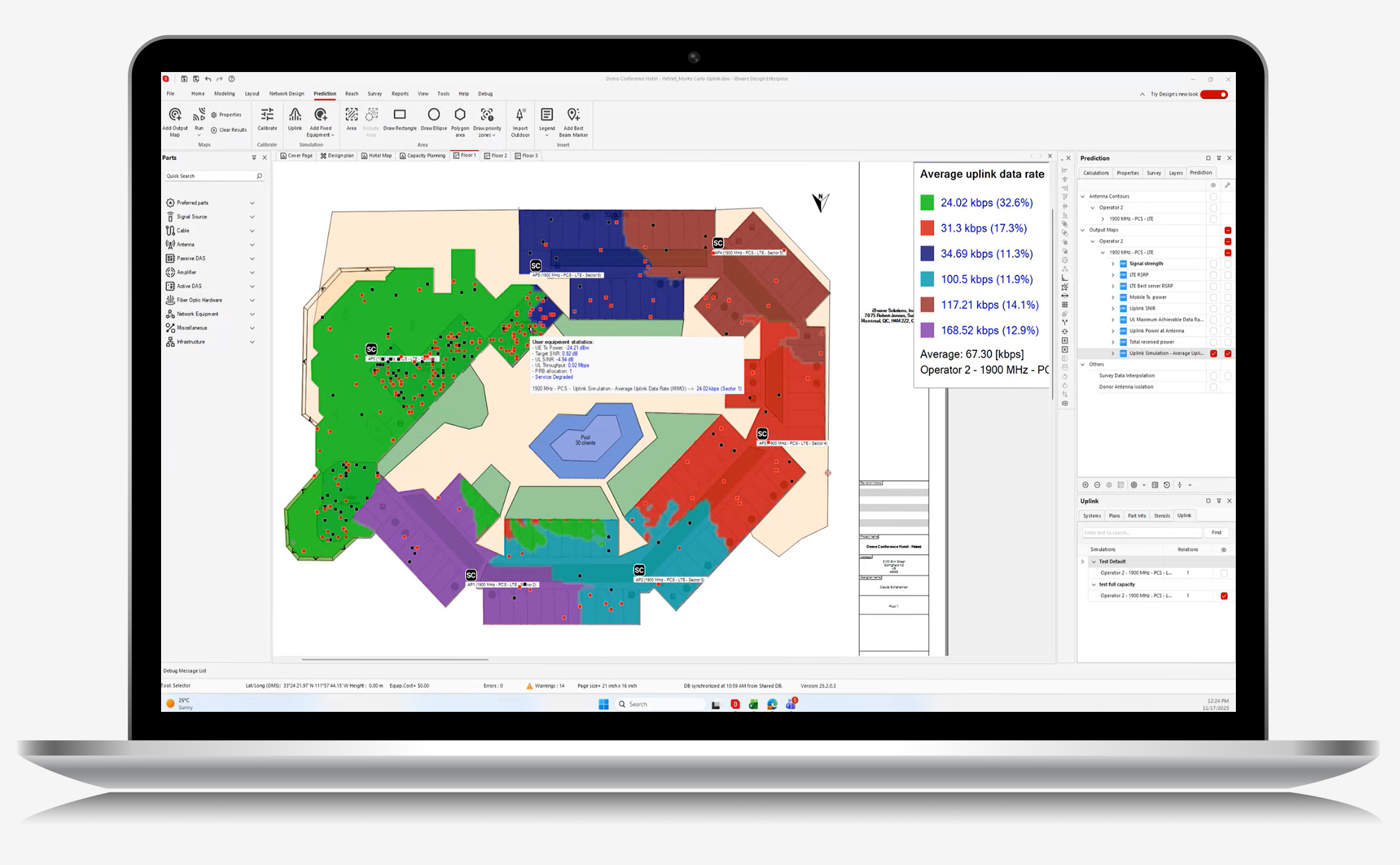
Especially in demanding environments such as production halls, logistics centers, hospitals, office buildings, or expansive outdoor areas, professional wireless network planning creates a reliable foundation for subsequent implementation.
Using iBwave simulation, potential coverage gaps, suboptimal access point locations, or insufficient capacity can be identified early on. This reduces installation effort and avoids costly rework.
The result: a Wi-Fi infrastructure specifically designed to meet the coverage, capacity, and availability requirements of your specific location.
The site survey, also known as station planning, is a technical inspection where all aspects relevant to implementation are recorded and coordinated with other trades. This involves capturing all necessary details for coordination with other on-site contractors, including determining the location of all equipment (indoor/outdoor), identifying necessary antenna mounts, equipment cabinets, etc., and defining the routing for data and power cables. Once the site survey is complete, all the facts are on the table, allowing for the derivation and determination of almost all implementation costs.
Based on the technical requirements and site conditions, we develop a suitable solution design for the entire infrastructure. In doing so, we take into account factors such as network architecture, access points, backbone, power and data supply, and integration with existing systems.
This creates a technically coordinated and transparent foundation for the subsequent implementation.
We are happy to support you in all areas of your tender for IT/IoT infrastructures.
Defining technical requirements and evaluable criteria can be complex, especially in IT infrastructure projects, but it is always critical to the project's success.
We support you through the tender process in 5 steps.
During the preparation of tenders, the decisive framework parameters for all subsequent steps are established. From setting a binding schedule and pre-qualifying bidders to launching the tender, your project takes shape step by step.
The foundation for implementing services after the final award is laid during the creation of the tender documents. This is where all relevant information is described and defined to enable bidders and applicants to submit targeted proposals.
Our support services for conducting tenders ensure that all necessary individual steps are completed on schedule. The equal-treatment information transfer ensures that all bidders and applicants receive identical information.
Evaluating bids is the central component of the entire project. This involves more than just comparing prices; it is about identifying the most economical offer while examining all bids for plausibility, feasibility, and award options.
As an IT specialist firm, we support you through all of the following process steps:
We support you with our technical expertise in the IT/IoT infrastructure segment throughout the final procurement process.